Oh, a Storm was Threatening:
When the Stones Played the Superdome in 2019
In July of 2019, as Tropical Storm Barry began to gather momentum in the Gulf of Mexico, thousands of tourists were desperately trying to get out of New Orleans. Most of the city’s levees had been reinforced since 2005, but the Mississippi was predicted to crest well above the high-water mark of Katrina, and the Crescent City was already flooding.[1] Waterspouts arose from Lake Pontchartrain, bending at strange, unnatural angles like long, crooked fingers. States of emergency were declared. Conventions were called off. In an act of remarkable generosity, the Delta Sigma Theta sorority donated the 17,000 meals that had already been purchased for its own convention to the Second Harvest Food Bank. The city braced for yet another storm.
The Greatest Rock ‘N’ Roll Band in the World would have been justified in canceling their No Filter tour stop in the city. But as flights into Louis Armstrong International Airport were being suspended, the Stones tweeted, “We’re here with you – we’ll get through this together.”[2] The band was already in the city and seemed determined to stay.
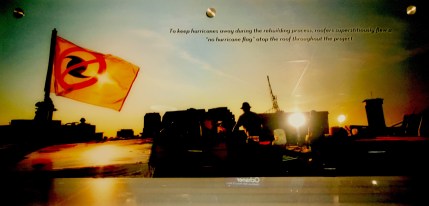
There is something apropos about catching a Rolling Stones show in New Orleans. If not a point of origin exactly, the Big Easy is certainly one of the cardinal points of American music. The Stones have taken up so many of these genres and traditions that playing in that city could seem like paying homage. But beyond music, there were other connections to be found between the band and the city. In the New Orleans Historic Voodoo Museum, the wooden figure “Three Headed Ju-ju,” carved by folk artist Herbert “Coon” Singleton, “defies and mocks evil spirits by sticking its tongues out.”[3] For a Stones fan inclined to study folkways, the band’s infamous Tongue & Lips logo might suggest a similar expression. Before Barry made landfall, a red floodlight projected the Tongue & Lips on to the wall of the Superdome. On those nights, the band’s emblem was like a talisman against bad weather – not unlike to the anti-hurricane flag raised as workers repaired the roof of the Superdome back in 2006.
Perhaps the Rolling Stones stayed because they didn’t want to disappoint the Big Easy a second time, as the band was supposed to headline the New Orleans Jazz and Heritage Festival in May but had to reschedule because of Mick Jagger’s heart surgery. Perhaps the band’s 83 permanent crew members and 45 equipment trucks had already arrived by the time that Barry began to form in the Gulf.[4] Perhaps the band wondered if and when they’d have the chance to play NOLA again. Whatever the reason, the Stones sheltered in place like everyone else.
Hurricane Barry did not live up to expectations. Still, for a city so dependent upon tourism, the damage was done. But flights began to arrive at the airport again – as did thousands of Stones fans. In turn, innumerable shops, hotels, museums, galleries, liquor stores, restaurants, chefs, servers, bartenders, Lyft and Uber drivers, rickshaw cyclists, drumlines of kids beating plastic buckets, dive-bar and street musicians – and yes, honkytonk women (and men) – ended up making money that weekend.
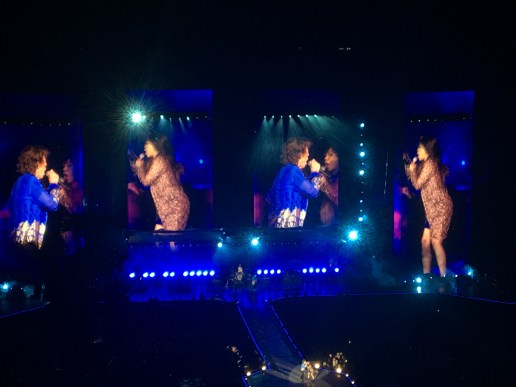
Barry could have been worse. There was no guarantee that things would turn out the way they did. But on July 15 (as the show was, in fact, delayed a single day by the storm), the Rolling Stones played New Orleans for the first time in 25 years. The performance began with a searing montage of light, sound, color, Tongues & Lips, and allusions to the American flag and its national anthem. This was followed by the opening chords of “Jumpin’ Jack Flash.” When Mick sang, “I was born in a crossfire hurricane,” the crowd lost it. They had reached a frenzy state and never really came back down. With four, six-story LED screens blazing with the highest definition video possible[5] (as captured by several carefully choreographed camera people who followed Mick, Keith, Ronnie, and Charlie, respectively – as well as bassist Darryl Jones, backing vocalists Bernard Fowler and Sasha Allen, and supporting musicians Chuck Leavell, Tim Ries, Matt Clifford, and Karl Denson), the July 15 show may have been the band’s finest in years. Because of the technology integrated into the performance, there really wasn’t a bad seat in the house – even if that house was holding nearly 40,000 people.
During the evening, Jagger acknowledged that he felt a sense of obligation to NOLA, saying, “You know, so many amazing musicians come from here. We owe them a great debt. We want to thank everyone very much, all those great people. We want to thank you very much for coming back to see us again.”[6] Perhaps that’s why the band stayed.
To turn to politics at this point might seem distasteful. Mick in particular has complained about “being used as a political football”.[7] But if some rock stars should not be politicized, perhaps certain issues should also transcend politics – like global warming, for example, which is so obviously affecting almost everyone who doesn’t have access to a working air conditioner and a panic room. The decision not to cancel, of course, may have arisen out of professionalism. But the Rolling Stones may have also modeled a type of social responsibility that is seriously lacking in many quarters today. As a massive storm was forming in the Gulf, the band did what even federal, state, and local agencies did not do back in 2005: the Rolling Stones did not abandon New Orleans. Moreover, the band recognized their own connections with – and indebtedness to – that culturally rich (if economically struggling) city and did their best to give back some part of what was owed. And call it the catharsis of rock ‘n’ roll, but some in the audience may have projected their own “crossfire hurricane” on to lyrics originally inspired by a German air raid that took place over Dartford, England, on December 18, 1943 – the day Keith Richards was born.[8] To recognize our own suffering in the suffering of others and to want to alleviate such hardship is not socialism. It is empathy.
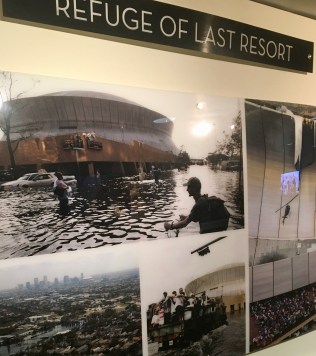
Now, near Gate A of the renovated Mercedes-Benz Superdome, you can find a few photographs depicting the city and its people during the aftermath of Hurricane Katrina. One day all too soon, the water may return. But on July 15, 2019, fans took in a Stones show in the same “Refuge of Last Resort” where thousands of evacuees waited for rescue almost fourteen years before.[9] To play “Gimme Shelter” in such a place seemed like a deliberate choice. In the course of an encore, the song became an elegy and prayer.
[1]Andone, Dakin, Paul P. Murphy, and Brandon Miller. “New Orleans faces a never-before-seen problem with Tropical Storm Barry.” CNN.com. July 12, 2019. https://www.cnn.com/2019/07/11/weather/new-orleans-flooding-trnd/index.html .
[2]The Rolling Stones: The Official Twitter for the Greatest Rock ‘N’ Roll Band in the World, the Rolling Stones. All Tweets from the Tongue & Lips.July 12, 2019. https://twitter.com/RollingStones?ref_src=twsrc%5Egoogle%7Ctwcamp%5Eserp%7Ctwgr%5Eauthor .
[3]The New Orleans Historic Voodoo Museum, New Orleans, Louisiana.
[4]The Rolling Stones: The Official Twitter for the Greatest Rock ‘N’ Roll Band in the World, the Rolling Stones. All Tweets from the Tongue & Lips.July 18, 2019. https://twitter.com/RollingStones?ref_src=twsrc%5Egoogle%7Ctwcamp%5Eserp%7Ctwgr%5Eauthor .
[5]Snider, Mike. “The Rolling Stones 2019 tour: Bigger, better video screens bring Mick & Keith up close.” USA Today.com.July 3, 2019. https://www.usatoday.com/story/tech/news/2019/07/03/rolling-stones-2019-cleaner-high-tech-stage-showcases-band-1/1641436001/# .
[6]Qtd. in Wirt, John. “Finally: Rolling Stones Deliver Satisfaction at The Mercedes-Benz Superdome.” OffBeat.com. July 16, 2019. https://www.offbeat.com/news/finally-rolling-stones-deliver-satisfaction-mercedes-benz-superdome/ .
[7]Goodwyn, Tom. “Mick Jagger pulls out of David Cameron hosted political event.” NME.com. January 25, 2010. https://www.nme.com/news/music/the-rolling-stones-289-1272046 .
[8]Wurzer, Cathy. “Keith Richards was born in a crossfire hurricane.” MPR.org. June 19, 2018. https://www.mprnews.org/story/2018/06/19/jumpin_jack .
[9]Scott, Nate. “Refuge of last resort: Five days inside the Superdome for Hurricane Katrina.” USAToday.com. August 24, 2015. https://ftw.usatoday.com/2015/08/refuge-of-last-resort-five-days-inside-the-superdome-for-hurricane-katrina .
*****

Rising
Farrah Field
New York: Four Way Books, 2009
68 pages; paper, $15.95
“Tone . . . is a theatrical enterprise,” Tony Hoagland writes in his essay “Sad Anthropologists” (91). In the same essay Hoagland acknowledges the difficulty in explicating tone, as it “is such an ambient, fluid, and internal quality in writing, one constructed from so many shifting elements (diction, music, pacing, image, syntax), that to define it is an elusive, probably impossible task” (83-4). In Rising, Farrah Field’s first book of poems, quick, agile fluctuations in tone both dazzle and reveal narrative exposition—that is to say, the background information that an audience would need to know or discover in order to make sense of a particular situation being presented to them. It’s possible that Field’s precise, coloratura use of tone may have made this collection stand out for Hoagland, who selected it for the 2007 Four Way Books Levis Prize. Field’s poems pass easily through dialects and levels of formality, ranging from the profane to the colloquial to the Biblical in idiom. These poems use all of the language and waste nothing. With their tonal pyrotechnics, the poems of Rising illuminate whole landscapes of subjectivity that might have otherwise remained in darkness.
In Rising’s proem, “Self-Portrait in Toad Suck, Arkansas,” the dissonance between the speaker’s knowledge of what will happen in the future and the poem’s folkloric tone that sets it in the mythic past begins to reveal the narrative exposition of the poems to come:
There’s a girl walking a gravel road
not even on a map. Even her elbows
sweat, but she’s always carnal, never cooler.
The Devil abducts himself in the rice fields.
She has already outlived her older sister
and determines: I am blessed but not by God.
O fucking forever glory. All must collapse
and wither. Yes, the smile and the nibbled boy’s ear.
She crosses the yard to a birthday party.
There are candles in the trees and everyone
is gathered for a picture. She steps in the middle. (3)
In a trick of visual perspective—or possibly a flashback to a more childlike perspective—birthday candles appear to be in trees. Shifts in tone also suggest shifts in perspective over time, hinting at what has happened to these characters or what discoveries have been made between the day this photograph was taken and the narrator’s return to this photograph years later. The girl depicted here is already “carnal”—fully alive and at home in her own flesh—as evinced by the way she sweats even from her elbows. The line “The Devil abducts himself in the rice fields” brings us into a possible folktale but also suggests that the Devil imagined in childhood will eventually disappear—setting this girl free from religiously reinforced ideas of duty and propriety.
Additionally, “Self-Portrait in Toad Suck, Arkansas” hints at something more elegiac in the poems to come:
O fucking forever glory. All must collapse
and wither. Yes, the smile and the nibbled boy’s ear.
An expletive used for emphasis or to indicate an ironic reversal or as a crude synonym for sex suddenly leads to an awareness of death, turning this photograph into a memento mori for the speaker. Even though this poem is set within the illusory permanence of the historical present, the photograph’s very existence has made the speaker aware that all will fade.
This foreknowledge may be at least partly responsible for Rising’s rich tonal tapestry. There are ongoing exchanges in these poems between speakers and those no longer present, as well as past and present selves. These poems are often deliberately set within the act of utterance, both in their highly theatrical nature and their willingness to utilize the spoken language. There are also some fine aphoristic moments in these poems, as in “Midnight Catfish,” when the poet admonishes herself to “Shake the prongs of kudzu or lose the accent, girl.” (14)
Many of the voices in these poems are decidedly Southern, but the poem “The Disturbed Mississippi” could invoke either Faulkner’s If I Forget Thee, Jerusalem (and the poet acknowledges that it does in the notes in the back of the book) or more recent images of Hurricane Katrina:
Most of the bank-side trees are naked as bones.
The river—
this Bible-leather Vesuvius, this southern
milk, rapid mud, not-black malted alluvial pain
that fossilizes levees with soot,
weird and monstrous, heart
and dammed—is shrinking where it should not. (8)
Additionally, many of these poems take place on a recognizably Biblical terrain, even if it is seldom overtly acknowledged as such. In “Midnight Catfish” two people night-fishing keep an eye out for serpents (“Copperheads always answers What was that.”) (14) In “Malvern, Arkansas” a Biblical parallel is subtly invoked in the telling of a story of youthful sexuality:
We weren’t liars
when we were kids. We wore boots that slid
off easily. The barn was a kind of red that shrank
on the wood each year. When Reverend John’s
boy broke his foot, the barn was deemed unfit.
[…]
Moths dive in when the fire is lit. The old lust bakes
and rises, searching for a new home. Two teenagers
steal away into a garage. Parishioners are singing
and clapping. The pile breathes a steady popping.
I heard Chet heaving behind me when I said,
No, baby, use two fingers. (10)
As the barn is burning, the speaker remembers her own past sexual exploits there. But as she watches two teenagers sneak away with similar intentions, the lust associated with the burning barn becomes like the demons cast out of a man in the Gospel of Mark—demons that eventually took possession of animals instead. Even as those demons couldn’t be eradicated but needed to find another host, youthful lust cannot be stamped out by Reverend John and all of his parishioners.
But despite the quick wit and brazen sexuality of these poems, Rising seems at times to be a book-length elegy for the poet’s sister, who was killed in an act of domestic violence. This elegiac current may also help to explain why the tonality of these poems can fluctuate so wildly. Grief is unpredictable. In The Dominion of the Dead Robert Pogue Harrison calls it “chaotic,” (58) and suggests that it threatens to “plunge the mourner into sheer delirium or catalepsy” (57). Despite Field’s natural wit, grief keeps surfacing in these poems. The poem “In Opelousas” offers one of many meditations on grief:
Candle wax
spills on my hand and I want it to scar. After kissing her casket good-bye,
I cried so hard I forgot who I was. Someone touched my arm. What’s an arm. (34)
Ultimately, Rising’s shifting tones suggest a type of Heraclitian energy in a universe where the temptation is to stand very still in grief. In all its wit and defiance, Rising is a chthonic response to the violence of the poet’s sister’s death. Eventually, the narrative persona of the poet becomes a presence that refuses to yield to the commonplace miseries that others accept as their lot and duty. In the poems of Rising, Field demonstrates a kaleidoscopic aptitude for tone and an uncommon freedom from the strictures of habit and tradition—in poetry or otherwise.
Works Cited
Field, Farrah. Rising. Tribeca: Four Way Books, 2009.
Harrison, Robert Pogue. “The Voice of Grief.” The Dominion of the Dead. Chicago: U of Chicago P, 2003. 55-71.
Hoagland, Tony. “Sad Anthropologists.” Real Sofistikashun: Essays on Poetry and
Craft. St. Paul, Minnesota: Grey Wolf Press, 2006. 83-106.
*****

Dark Card
Rebecca Foust
Huntsville: Texas Review Press, 2008
36 pages; paper, $8.95
During the trick known as the “Dark Card,” a magician appears to transform the color of a single playing card. Rebecca Foust’s Dark Card, winner of the 2007 Robert Phillips Poetry Chapbook Prize, opens with a title poem in which the mother of a boy with Asperger’s syndrome tries to explain her son’s behavior by creating comforting illusions and having him perform “parlor tricks” for onlookers. (1) At first, she tries to pass her son off as an “idiot savant”—although that title understandably stirs up cognitive dissonance for her—instead of attempting to better understand how her son actually thinks and experiences the world. (1)
Rebecca Foust has been an outspoken advocate for children with autism spectrum disorders and the parents of these children; her own son, in fact, was diagnosed with Asperger’s syndrome. The poems in Dark Card seem autobiographical in their narration of the development of her son—who is named in the book’s dedication—from birth to young adulthood. In the years following the passage of the Americans with Disabilities Act, a new category of poetry—“disability poetry”—has begun to emerge in American literature. Jim Ferris, author of The Hospital Poems and a scholar of disabilities studies, asserts that “Disability poetry can be recognized by several characteristics: a challenge to stereotypes and an insistence on self-definition; foregrounding of the perspective of people with disabilities; an emphasis on embodiment, especially atypical embodiment; and alternative techniques and poetics” (qtd. in Northen). Dark Card partially fulfills Ferris’ criteria, as Foust challenges stereotypes about Asperger’s syndrome as early as the title poem, where she hints at the boy’s tremendous empathy for other living things. Foust’s chapbook also deviates from Ferris’ formulation, however, as the guiding viewpoint in this collection is that of the mother of a boy with Asperger’s and not the boy himself. But it is out of her not-knowing—especially her difficulty in understanding her son—that the kaleidoscopic tonalities of Rebecca Foust’s voice emerge. She picks up the strains of other voices as she attempts to determine the cause of her son’s disorder and better understand how he sees the world. Foust also summons her own viewpoints from the past—even if her perspective has changed—and turns with lapidary brilliance and precision to address very different audiences.
In the title poem, the poet compares herself to a magician in the ways she attempts to present her son to others. But she becomes less comfortable with this “tap dance-and-shuffle routine”, as she calls it, and a type of self-consciousness begins to creep into her voice, undercutting her explanations:
Yes, he’s different, all kids are different, him
just a little bit more—oh, he’s knocked down
the applesauce pyramid? So sorry, here,
my sleeves conceal napkins for messes like this,
and I can make them disappear. But before I do,
make sure you marvel at how the jars
made an algorithm when he pulled that one free.
Oh, he was standing on his desk again, crowing
like a rooster in your third-period class?
Yes, bad manners, and worse luck
that he notices how today’s date and the clock
matched the hour of what you taught
last week in a footnote—the exact pivotal
second of the Chinese Year of the Cock. (1)
As the poet begins to doubt her ability to explain her son’s behavior, she seeks to better understand its causation. Foust also realizes that the interpretations meant to reassure nervous onlookers may actually distract them from her son’s intelligence and ways of perceiving the world, and confesses that presenting him to others as an “idiot savant” is
a swindle, a flimflam, a lie,
a not-celebration of what he sees
with his inward-turned eye… (2)
One arc of this collection attempts to better understand the world as it is perceived through that eye.
As she looks back at possible causes of her son’s disorder, Foust considers the circumstances surrounding her son’s difficult, premature birth. In the poem “Palace Eunuch,” Rebecca Foust demonstrates an ability to create a complex and surprising allegory even as she expresses ferocious indignation:
You work in the palace of God
charged with the guard
of his most precious treasure,
the inventory of innocents,
but you’ve grown drunk
with power, forget who you are.
You spoke with the authority
to give or take life,
but your voice squeaked
when you asked
wouldn’t I rather go home,
just go on home,
just have my baby at home.
Don’t say you were trying to be kind,
you ball-less prick soft dick eunuch
cowardly coin-counting conservator.
You were practically pissing yourself
in your fear of malpractice,
you were shaking
in your green paper booties. (4)
If this mother had attempted to deliver her child at home, her son would have almost certainly died, and with this hindsight—or in spite of it—Rebecca Foust demonstrates amazing precision and control in the slow reveal of “Palace Eunuch.” It is only in the final line of the poem that we discover the eunuch’s “green paper booties” and sense that he had an actual role within the delivery room.
As her son matures, Foust discovers that society’s attention—not her son’s—may be misdirected, and that her son, rather than being disabled, possesses an unusual keenness of perception. This understanding crystallizes in “The Peripheral Becomes Crucial”:
The Peripheral Becomes Crucial
in ways we’d never have guessed, like when
they unwound the crocodile-mummy shroud
focusing on what was within,
casting aside as trash the papyri cartonnage,
which when kicked, unscrolled to reveal
what Sappho wrote… (36)
The son’s perceptiveness is not a Miltonian compensatory gift, however; for this exchange might suggest that the son has not always had his extraordinary vision, or that he has some deficiency that should solicit an audience’s pity. Such appeals to pathos do not often manifest themselves in Dark Card and would not be in keeping with the objectives of early practitioners of disability poetry, who, as Michael Northen explains, “eschewed sentimental poetry that made disability the object of pity or charity” (Northen). Foust’s poetry seems weakest, in fact, in the few poems in Dark Card where sentimentality prevails (i.e., the poem “Sweet Heart,” where a “ravening pack // of playground boys” are compared to dingos as they rip out her son’s heart—“a mere gateau”—and hang it on “Friday’s cross” (13)). But by the end of Rebecca Foust’s collection, the son’s behavior in childhood is inseparable from his finely tuned perception. Both are manifestations of the same thing, and that syndrome—as might have been feared with an Autism spectrum diagnosis decades ago—will not destroy him.
These poems, however, do not constitute a type of advocacy poetry that takes up its subject with little regard for craft. The poet’s techniques and the book’s project—to better understand the “iceberg depth” of the son’s perceptions, though “His face is blank as a kettle pond / dawn…” (“Underneath” 26)—are inseparable. Empathy and attention to fine detail are critical traits for both poet and son. The empathy that allows for Rebecca Foust’s multifaceted language has a counterpart in the unusual perceptiveness of the son, even as the poet challenges the stereotype that her son lacks empathy by demonstrating his very pronounced concern for other living things. But the poet’s dexterity with allegory, the line, and most especially, tone suggests that Rebecca Foust has a poetic ability that will extend far beyond a single narrative or subject.
Works Cited
Foust, Rebecca. Dark Card. Texas Review P: Huntsville, 2008.
Northen, Michael. “A Short History of Disability Poetry.” Wordgathering: A Journal of Disability Poetry. 2.1 (March 2008). http://www.wordgathering.com/issue5/essays/northenessay.html .
 Carol Quinn